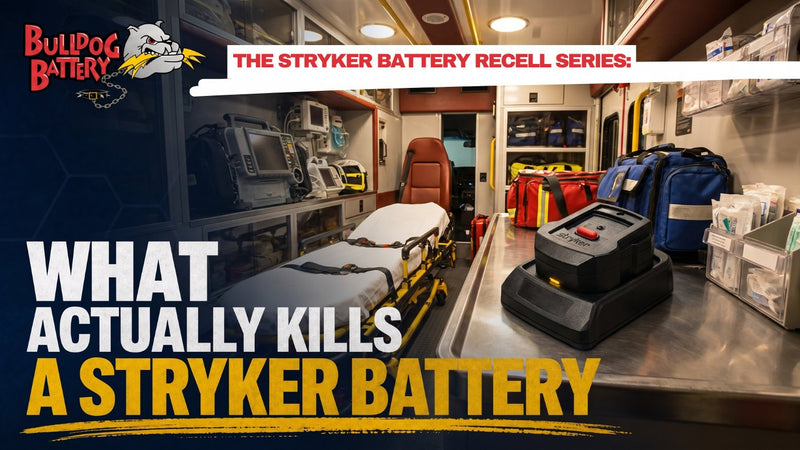
Your Stryker battery didn't die this morning. It has been dying for weeks, maybe months, and nobody told you what to look for. The charger light was green. The stretcher was running. Then it wasn't.
I talk to EMS operations managers every week, and the story repeats. A battery that seemed fine yesterday flashes yellow on the charger. A crew notices the cot lifting slower at the end of a shift. A supervisor walks in Monday morning to a pile of packs that won't take a charge.
After a decade in the battery business and thousands of Stryker SMRT Paks across our bench, I can tell you these failures aren't random. They give warning. Most people just haven't been told what the warnings are, so here they are.
Sign #1: Your batteries aren't lasting a full shift anymore
A fully charged Stryker SMRT Pak should give you 15 to 20 calls at an average patient weight of 250 pounds. That number comes from Stryker's own technical documentation. If your crews are swapping batteries mid-shift, or can't get through a rotation on one pack, something has changed.
In busy 911 agencies, I see OEM batteries come back at about twelve to fifteen months. That is the real-world lifespan in a high-volume operation, not the number on the spec sheet.
The reason is the chemistry. The OEM Stryker cells are NiCd (nickel cadmium), and NiCd suffers from memory effect. Repeated partial charges teach the cells to deliver less than they used to. The battery still charges. It still turns green on the charger. It just runs on a shrinking fraction of its original capacity.
What makes this hard to catch is that runtime doesn't fade evenly. The pack works fine until one day it doesn't. Crews might notice a little less performance, but by the time anyone flags it, the battery is already past saving.
I wish every EMS ops manager knew they were overpaying, and that there was another option. We are that option.
Sign #2: Your charger says 100%, and it's wrong
This is the one that catches the most people off guard.
A degraded Stryker battery will still take a full charge. The charger reads it as complete and turns the LED green. Your crew grabs what looks like a fully charged pack, slides it onto the stretcher, and heads out. The capacity isn't there anymore, and they find out mid-shift when the battery quits hours early.
The charger isn't malfunctioning. It measures voltage, not capacity. As long as the cells reach the target voltage during charging, it gives the green light, even when those cells can only hold a fraction of the energy they held new. Every NiCd charging system works this way.
The gap between "looks charged" and "actually has capacity" is where the operational risk lives, and it stays invisible until somebody is standing next to a stretcher wondering why the battery just died.
Sign #3: The charger is flashing yellow
Flashing yellow on the Stryker SMRT Charger is the failure signal we hear about most. The full set of LED codes, and what to do about each one:
| What It Means | LED State | What to Do |
|---|---|---|
| Fully charged and ready | Solid Green | Good to go |
| Actively charging | Flashing Green | Normal. Wait for solid green. |
| Battery error detected | Solid Amber/Yellow | Fully charge 2 hrs, then retest |
| Temperature delay or persistent error | Flashing Amber/Yellow | Let cool 4 hrs, retry. If it persists, the pack needs service. |
| Battery needs recharge/replacement | Flashing Red (on cot) | Replace with a charged pack immediately |
| Battery error | Solid Red (on cot) | Pull from service. Needs evaluation. |
If a battery keeps flashing yellow on the charger, that pack is at or near the end of its life. Cycling it back into the rotation and hoping it recovers doesn't work. It won't recover.
Heat is the other signal, and it doesn't come from the charger at all. Customers regularly report batteries running noticeably warmer than normal as they approach failure. A battery that gets hot on the charger is dissipating energy it should be storing, and that is a safety flag as much as a performance one.
Sign #4: The stretcher feels sluggish
This one doesn't show up on any dashboard. It shows up in the field, from the crews who run the equipment every day.
Customers tell me they notice the Stryker stretcher lifting slower late in the day, or when a battery is near the end of its life. That tracks. A degraded battery delivers lower voltage under load, and lower voltage means less power to the lift. The stretcher still works. It is just slower and less responsive.
That sounds minor until you picture it. Twelve hours into a shift, a tired crew, a heavy patient, and the cot hesitates on the lift. Somebody's back makes up the difference. At that point it stopped being a battery problem.
The trouble is that this symptom rarely gets reported upstream with any detail. The battery lands on a supervisor's desk in the morning, or somebody writes "bad" on it with a marker. What the crew actually experienced, the slow lift and the hesitation, never makes it into a maintenance report.
Sign #5: You're buying batteries more often than you used to
This sign shows up in the budget meeting, not on the charger.
If you replaced two Stryker cot batteries last year and you're on pace for four this year, the pattern is telling you something. Your fleet is aging and the replacement cycle is compressing. At $686 per OEM pack, that adds up fast.
For a 10-cot operation, going from two replacements a year to four is an extra $1,372 in unplanned battery spend. Scale that to a 35-truck fleet and you're looking at thousands of dollars that never made it into a forecast, because nobody planned for the acceleration.
Underneath the numbers is how NiCd cells age. The decline isn't linear. The first year or so is relatively stable, then capacity drops off hard. Once one battery in a batch reaches that point, the rest are close behind.
Sign #6: One battery failed, and the rest of the batch is next
Batteries bought at the same time and run in the same fleet see the same temperatures, the same charging habits, and the same call volume. There isn't much to make one pack age differently from the next. They follow the same curve.
Customers who have been through it know this instinctively. One failure is the first of several, and the others are usually a few weeks behind.
This is where replacing packs one at a time falls apart. At $686 each, you aren't solving anything, and by the time you've handled the third failure, the fourth and fifth are already showing symptoms.
Thinking at the fleet level changes the math. Instead of chasing individual failures after they happen, you plan a batch ahead of the expected failure window and keep the whole fleet reliable.
Sign #7: You've got a pile of dead batteries in a closet somewhere
Almost every EMS operations manager I call has a stockpile of dead Stryker power cot batteries sitting on a shelf in a back room. Nobody knows what to do with them.
Some agencies took them in for recycling and got charged a disposal fee. Some threw them away. Most are collecting dust because nobody offered a better option.
What surprises people is that most of those packs aren't dead. The housing, the board, and the connectors are all reusable. What's dead are the NiCd cells inside, worn out after thousands of charge cycles. Everything Stryker engineered around those cells still works, and the cells can be replaced.
What's Actually Happening Inside Your Battery
You've never opened a Stryker SMRT Pak, and neither have most ops managers. But knowing what's inside explains why all seven of these signs happen.
The OEM SMRT Pak runs on NiCd cells, a chemistry that has been around for decades. NiCd is reliable and handles high-rate discharge well, which is why Stryker chose it for EMS work. Its well-known weakness is memory effect.
Every partial charge takes a small toll. Pull the pack off the charger before it finishes, or put it on before it's fully drained, and crystals form on the electrodes. That reduces the surface area available to store energy, raises internal resistance, and speeds up self-discharge.
Stryker's own manual notes that a SMRT Pak can lose up to 30 percent of its charge within 48 hours of coming off the charger. That's the spec for a new battery. A degraded one loses charge faster.
What still surprises me after more than ten years of this work is how simple these batteries are compared to what they cost. The SMRT Pak is a well-built housing with good electronics wrapped around a set of standard NiCd cells. When the cells wear out, the whole $686 pack gets treated like trash, even though the housing, the board, and the BMS are fine.
The cells are a replaceable part. Think of them as the tires on a truck: the truck is fine, the tires wore out.
What To Do When You See These Signs
If you recognized your fleet in any of the signs above, this is the practical path forward.
Immediate: Pull any battery that keeps flashing yellow, runs hot on the charger, or shows physical damage. Label it and take it out of the rotation. It isn't going to recover.
Short-term: Check which batteries in your fleet came from the same purchase. If one is failing, the others are on the same timeline. Plan for the batch, not the single pack.
Assessment: Look at what you're spending. OEM Stryker replacement is $686 per battery with a three-week lead time. A complete kit with two batteries and a charger runs $2,044 and is frequently backordered. If you're replacing several packs a year, that's a real line on the P&L.
Know your options: OEM replacement isn't the only path. Professional recelling replaces the worn cells inside your existing SMRT Pak with higher-capacity NiMH cells. You get a battery that works with your existing charger, delivers roughly 20% more runtime, and costs less than half of OEM, with a one-year free replacement warranty and a 30-day money-back guarantee. It's your pack, with better cells in it.
And if you have that pile of dead packs in a closet, don't assume they're headed for the trash. Most can be recelled and put back in service. The full process, start to finish:
→ What Is Stryker Battery Recelling?
To see the numbers for your own fleet, OEM versus recelled versus generic, year by year, we built a free calculator. No email required:
→ Stryker Battery Savings Calculator
Frequently Asked Questions
How long should a Stryker SMRT battery last?
In high-volume 911 agencies, we see OEM batteries coming back at around twelve to fifteen months. Moderate-use environments may get longer. That's based on field data from 150+ EMS agencies.
What does flashing yellow on my Stryker charger mean?
A flashing yellow (amber) LED means a battery error or a temperature delay. It's the most commonly reported signal of a failing SMRT Pak. A battery that keeps flashing yellow is at or near the end of its life.
Why does my Stryker battery die so fast?
NiCd memory effect from repeated partial charges. The cells lose capacity over time while the charger keeps showing 100%, so the loss stays invisible until the battery can't make it through a shift.
Can Stryker batteries be repaired?
Yes. The cells inside can be replaced through professional recelling, which reuses the OEM housing, motherboard, and connectors. New NiMH cells deliver 3.0 Ah versus the original 2.5 Ah, roughly 20% more runtime, and work with your existing SMRT charger.
→ Read: What Is Stryker Battery Recelling?
How much does a Stryker SMRT Pak cost?
OEM: $686 per battery, with about a three-week ship time. Complete kit (two batteries and a charger): $2,044, frequently backordered. Professional recelling: $325 per battery, about a one-week turnaround, free shipping both ways.
Will my crews need new chargers?
No. Recelling replaces the cells inside your existing SMRT Pak, so the pack still works with your SMRT Charger, still charges on the Power-LOAD in the ambulance, and operates exactly as it did before. No new equipment and no retraining.
Want To Talk Through Your Fleet's Situation?
If you're seeing these signs and want to understand your options, we're happy to walk through it with you. No obligation. The first conversation covers your fleet size, what you're spending, and what the alternatives look like.
Most customers start with a trial run of two packs. Once they see how those hold up in the field, the rest follows.
Call Eric directly: 607-600-3001
Email: eric@bulldogbattery.com
Product: Re-celled Stryker SMRT Pak, $325